This school year has been so busy that I have not taken the time to write blog posts as often as I have wanted. We have been busily working through spelling lists, learning multiple digit addition and multiplication, memorizing parts of speech, practicing the piano, learning to swim, dancing, tumbling, and so on. Most Fridays, however, we take a break from our day-to-day assignments and work on a project together.
In January, after we finished reading My Side of the Mountain by Jean Craighead George, I gave Hannah and Ben each a box, set out the craft supplies, and told them to make a shadowbox based on the book. Both kids ended up making a model of Sam Gribley's woods and his home in the tree trunk, so I took advantage of that to teach them a little about habitats. On each side of the box, they glued a piece of card stock and labeled them with the title of the book, "Sam Gribley's Habitat," and the different aspects of his habitat: food, water, and shelter. Then, under those headings, they listed ways that Sam was able to obtain those things in the woods. For example, he drank water from a fresh spring, he hunted for animals with his falcon and ate edible plants, and he created a home in a hollow tree. The finished projects are lovely!
On the Friday before the Super Bowl, we dedicated the entire day to football-related activities. I found an amazing free resource on the website for the Pro Football Hall of Fame and combined with with another packet I got as a freebie from Currclick. I printed out a ton of pages, punched holes in them, and put them in folders for each kid. We began the day by bundling up and heading out to a nearby sports field, where we had a punt, pass, and kick contest, raced through various football drills, and performed an experiment to figure out why a football has its shape, instead of being perfectly round. Back at home, they learned about Roman Numerals (since that is how they label Super Bowls), did some football-themed math, read and wrote poems about football, learned about the first African American inducted into the Pro Football Hall of Fame, discovered how to read nutrition labels to eat a healthy diet (like a good athlete should!), and even designed their own football team mascots, pennants, and jerseys!
Also, in February, we had the opportunity for an amazing project on the planets. Now, as a family, we enjoy listening to classical music, and one of our favorites is The Planets by Holst. Josh discovered that the Springfield Symphony would be putting on a show called "Out of This World," featuring a live performance of The Planets, lovely NASA images from space, and dramatic presentations by an astronomy professor and an acting troupe. In preparation, we listened to the music several times and talked about the names of each planet and how the origins of those names inspired the songs. I also found a free space lapbook at www.homeschoolshare.com, and I used portions of that and our Children's Atlas of the Universe to put together a wonderful project on the planets. Additionally, I used the student guide provided by the symphony and resources from our Galloping the Globe study of Italy (which includes a section on space because Galileo was from Italy). I was out of town with the youth group on the evening of the show, but despite the two-hour drive each way, Josh and his mom took the kids to the performance, and they loved it! In fact, Becca announced on the way home that it was "better than Chuck E. Cheese's!"
We have had so much fun with our "Project Fridays" so far this school year. I believe that the kids have learned more from them than anything they have learned out of a text book. Even though I have to work a little harder to fit all of their other school work into only four days each week, I am certain that we will continue with Project Fridays for a long time!
Showing posts with label lapbooks. Show all posts
Showing posts with label lapbooks. Show all posts
Saturday, March 10, 2012

Monday, September 13, 2010
The Wheel on the School
Last week, Hannah and I finished the first chapter book we worked on together - The Wheel on the School by Miendert DeJong. What a lovely book! We both fell in love with it from the very first page. Lina, the main character, is so sweet and thoughtful and full of dreams. She reminds me very much of my Hannah!
At first, the book focuses only on the school children and their teacher, as they are the only "important" characters in the story. But gradually, more and more characters become "important" until the list includes the whole town and even some people in adjacent towns: the oldest man and woman, the young tots, the fathers, the women, the poor tin man, and even the once-outcast legless man with a cherry tree in his back yard. By the end of the book, everyone has come together to make Lina's "impossibly impossible" dream a reality.
Last Friday, Josh surprised Ben by taking him away for the weekend to a Virginia Tech football game with all of the guys on that side of the family. Since I didn't have to plan any school work for Ben that day, I decided to spend the whole day with Hannah working on a project to wrap up our reading of the book. I planned to do three lapbooks - one on the book, one on the Netherlands, and one on storks. In advance, I found a few printables from homeschoolshare.com, and I designed a few booklets myself. Using some non-fiction books from the library about the Netherlands and storks, Hannah and I planned out the rest of the ideas. She did most of the writing, though I wrote the titles on each item and the tiny labels on the timeline. I also filled in the main character list, when her hand became tired. Of course, she helped me by listing characters and describing the main events. Once we finished assembling the lapbooks, Hannah decorated the cover of each one. I am absolutely amazed at how they turned out!
The cover for the book lapbook:
 The inside of the book lapbook:
 The cover of the Netherlands lapbook:
 The inside of the Netherlands lapbook:
 The cover of the stork lapbook:
 The inside of the stork lapbook:
 In addition, during play time yesterday, I noticed that Hannah had used her Legos to build a replica of the village of Shora. The little girl even has on a pair of wooden shoes!
 Amazingly, Hannah has nearly finished reading the entire book for a second time on her own! The reading level is fairly challenging, but she loves the story so much that she does not mind. This is one reason why we opted to homeschool this year. Last year, school exhausted her so much that she never wanted to read on her own anymore. She seemed to have lost her love of reading. Obviously, that love returned once we provided a more restful and academically stimulating school environment. I am very excited by how this project turned out, and I am already considering our next one when we finish our new chapter book. I love how much fun learning can be - for my kids and for me!
At first, the book focuses only on the school children and their teacher, as they are the only "important" characters in the story. But gradually, more and more characters become "important" until the list includes the whole town and even some people in adjacent towns: the oldest man and woman, the young tots, the fathers, the women, the poor tin man, and even the once-outcast legless man with a cherry tree in his back yard. By the end of the book, everyone has come together to make Lina's "impossibly impossible" dream a reality.
Last Friday, Josh surprised Ben by taking him away for the weekend to a Virginia Tech football game with all of the guys on that side of the family. Since I didn't have to plan any school work for Ben that day, I decided to spend the whole day with Hannah working on a project to wrap up our reading of the book. I planned to do three lapbooks - one on the book, one on the Netherlands, and one on storks. In advance, I found a few printables from homeschoolshare.com, and I designed a few booklets myself. Using some non-fiction books from the library about the Netherlands and storks, Hannah and I planned out the rest of the ideas. She did most of the writing, though I wrote the titles on each item and the tiny labels on the timeline. I also filled in the main character list, when her hand became tired. Of course, she helped me by listing characters and describing the main events. Once we finished assembling the lapbooks, Hannah decorated the cover of each one. I am absolutely amazed at how they turned out!
The cover for the book lapbook:
 The inside of the book lapbook:
 The cover of the Netherlands lapbook:
 The inside of the Netherlands lapbook:
 The cover of the stork lapbook:
 The inside of the stork lapbook:
 In addition, during play time yesterday, I noticed that Hannah had used her Legos to build a replica of the village of Shora. The little girl even has on a pair of wooden shoes!
 Amazingly, Hannah has nearly finished reading the entire book for a second time on her own! The reading level is fairly challenging, but she loves the story so much that she does not mind. This is one reason why we opted to homeschool this year. Last year, school exhausted her so much that she never wanted to read on her own anymore. She seemed to have lost her love of reading. Obviously, that love returned once we provided a more restful and academically stimulating school environment. I am very excited by how this project turned out, and I am already considering our next one when we finish our new chapter book. I love how much fun learning can be - for my kids and for me!
Saturday, September 20, 2008
Discovering Lapbooking
I discovered a wonderful educational tool the other day that I think will become a regular part of our homeschooling curriculum. I cannot believe that I never learned about this in my four years as an education major at a college known for its high quality teaching program! It is called "lapbooking."
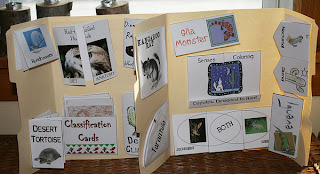
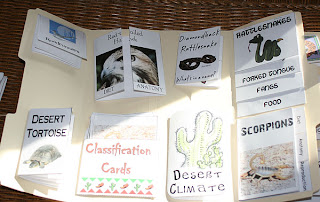
A lapbook is a manila file folder, flattened and refolded in a specific way in order to make a book. Various colorful pockets, pictures, and small books are glued to the inside of the folder, each item containing pieces of information about the lapbook's theme. At the kindergarten level, the information is usually fairly simple, but high school students put together lapbooks containing essays, charts, and much more complex information. Seem confusing? I, too, needed pictures and examples before I figured out exactly how it worked, so I will share our first lapbook with you.
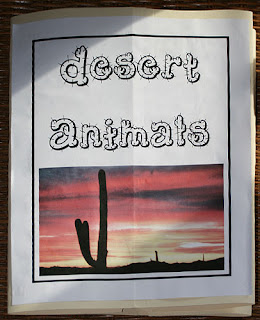
Because of Hannah's current fascination with scorpions, rattlesnakes, and animals that live in the Grand Canyon, I was thrilled to find a free "Desert Animals" lapbook at Home School Share. The pdf's on the site included printables and instructions to make a detailed lapbook about animals that live in American deserts. I did find that some of the information included was incorrect or incomplete, but for the most part, all of the facts needed were included on the webpage. If Hannah were older, I would have taught her how to look up facts about the animals by herself, but instead, I printed off the infomation, read it to her out loud, and had her pick out the facts we needed to make each booklet or activity. I wrote the details for her most of the time, but she wrote a few of the pages herself.
Hannah really seemed to enjoy lapbooking, especially since this lapbook focused on something that already interested her. Her love of bugs runs so deep right now, that when I showed her the photo labeled "scorpion," she announced that it was actually a giant desert hairy scorpion. I looked it up in our Audubon guide, and she was correct!
Here are a few pictures of the lapbook we finished yesterday. Ours actually ended up being two folders glued together on one side to make room for all of the little books and pockets.
A lapbook is a manila file folder, flattened and refolded in a specific way in order to make a book. Various colorful pockets, pictures, and small books are glued to the inside of the folder, each item containing pieces of information about the lapbook's theme. At the kindergarten level, the information is usually fairly simple, but high school students put together lapbooks containing essays, charts, and much more complex information. Seem confusing? I, too, needed pictures and examples before I figured out exactly how it worked, so I will share our first lapbook with you.
Because of Hannah's current fascination with scorpions, rattlesnakes, and animals that live in the Grand Canyon, I was thrilled to find a free "Desert Animals" lapbook at Home School Share. The pdf's on the site included printables and instructions to make a detailed lapbook about animals that live in American deserts. I did find that some of the information included was incorrect or incomplete, but for the most part, all of the facts needed were included on the webpage. If Hannah were older, I would have taught her how to look up facts about the animals by herself, but instead, I printed off the infomation, read it to her out loud, and had her pick out the facts we needed to make each booklet or activity. I wrote the details for her most of the time, but she wrote a few of the pages herself.
Hannah really seemed to enjoy lapbooking, especially since this lapbook focused on something that already interested her. Her love of bugs runs so deep right now, that when I showed her the photo labeled "scorpion," she announced that it was actually a giant desert hairy scorpion. I looked it up in our Audubon guide, and she was correct!
Here are a few pictures of the lapbook we finished yesterday. Ours actually ended up being two folders glued together on one side to make room for all of the little books and pockets.
The cover:

The inside:

A close up of one side:

Subscribe to:
Posts (Atom)