Showing posts with label science. Show all posts

Wednesday, April 24, 2019

A Hidden Habitat

I haven't written on this blog for a very long time now... almost 5 years now. In fact, I haven't written much at all in the past year. But, I miss it, so I may try keeping up with this blog again, if I can find the time.

Hannah is wrapping up her freshman year at the local high school, which Ben will also attend when he is a freshman next year. Becca is finishing 6th grade, and Kayla will actually be old enough for kindergarten next year!

I have been furthering my own education a bit as well. In the fall, I completed classes to become an Ohio Certified Volunteer Naturalist (OCVN), and this spring, I attended the Environmental Education Council of Ohio (EECO) annual conference. I have loved nature education since I was in college and worked at the Philadelphia Zoo. Though my certification was in Social Studies Secondary Education, I always had a longing to teach about nature and wildlife. Because of this passion, I have been volunteering a lot at our local nature center. I recently helped with a 5-week nature journaling program for 4th graders at an urban elementary school, and I will be assisting with many field trips at the nature center this spring. I love it!

I have also been incorporating even more environmental education into our homeschooling. This week, Ben had to take the state Geometry test on two separate mornings as part of his preparation for entering high school. The beautiful weather inspired me to take the rest of the school day outdoors.

We walked around our property and talked about nature - what we saw and what we wondered about. Becca kept dashing around looking under rocks and logs for red-backed salamanders, which we find all over our property. She did find a few, including this large gray one and one that measured only an inch from head to tail.

As we rounded the "hairpin," as the kids call the sharp bend in the walking path around our property, we glanced at all of the logs in various stages of decay next to the path. "Hey," I told her, "you should see if you can flip one of those really rotting logs and see what you find underneath." The log ended up being so rotten that it pulled apart instead of turning over.


 First, we noticed patches of white fungus spread across the inside of the log.


As we looked closer, we began to see even more signs of life: a tiny mushroom, a spider web and a small brown spider, myriads of tunnels with reddish brown ants scurrying through them, a salamander, a centipede, a beetle, and five or six of these beautifully colored millipedes. An entire miniature ecosystem lay hidden within an old log on the forest floor.


We decided to examine the millipedes a little more closely before returning them safely to their
rotting log. We learned that they are called Euryurus leachii, or Leach's millipede, and they primarily live in decaying hardwoods. Apparently, they even glow under a black light, though we didn't have the opportunity to test that out.

Becca, in particular, seemed to love this investigation. She and I talked about all of the things she had found, as we walked back toward the house. She wanted to find some way to demonstrate what she had learned. At first, she mentioned drawing a picture, but then we discussed other ways she could model the hidden habitat we had discovered. When we got inside, she instantly collected her craft supplies and got to work. I love her final results!

On the outside/front, she used green yarn to create a soft bed of moss with patches of bark showing through. She added a turkey tail fungus to the edge.


The front flips up to reveal the inside of the log, where she drew a millipede, ants and their tunnels, a centipede, a worm, a spider and a web, a mushroom, and streaks of white fungus.


I look forward to doing even more nature exploring with the kids in the future. I am amazed at how much we can learn when we begin to ask questions and look beneath the surface of what we see.  Just as we had to peel back the layers of the log to see the hidden world inside, we can also discover hidden realms of knowledge by just taking the time to stop and dig a little deeper into the world around us.

Friday, August 22, 2014

Back to Fun


I was going to title this post “Back to Work,” but that did not seem to fit the beginning of our school year so far. Sure, we have done quite a bit of work – math pages, grammar worksheets, history memory cards – and we have had to arrange teaching times around the baby’s naps. But, we have also had a lot of fun.

On Monday, Hannah and Ben learned about the center of gravity. They began by figuring out how to balance a potato on a ruler, using only a pair of forks. Then, they used what they learned to balance a broom on the palm of their hands by first identifying the broom’s center of gravity.

We also had our first Phys. Ed. Class on Monday. A few years ago, I got a free fitness and health package from Subway, including two pedometers, a stopwatch, and a year’s worth of lesson ideas and activities. The kids have gym once a week at co-op, but I want to add a bit to their learning at home as well. The kids loved experimenting with the pedometers, counting the steps needed to walk around the house or get the mail. Becca has even decided to eat a healthy breakfast every day, so she can feed her brain and maybe get better grades on her school work.

Today, Becca experimented with reading maps. I made a map of our property and marked several “treasures” on it. Then, she used the map to find the treasures – just a few nickles and gumballs. She needed a bit of help from Hannah to find the last few, but I may mark some more treasures next week and let her try again until she gets the hang of it.

I think everyone’s favorite lesson this week came from our new geography curriculum – Mapping the World with Art. We read a brief lesson on ancient maps and then followed several steps to draw maps of Mesopotamia. The kids’ maps are surprisingly good! The curriculum is supposed to be for ages 10 and older, but even Becca could follow the steps to draw a decent map. By the end of the year, the kids should be able to draw a map of the entire world!

After we drew the maps, we used edible chocolate clay to make Babylonian-type maps, using chopsticks and drawing cuneiform markings on them. I baked them, and everyone enjoyed delicious, warm chocolate map cookies with a glass of milk as an after school snack. I intended to take photos, but they did not last long enough. Geography should be a lot of fun this year!

I am so thankful that the kids have been working more willingly this school year. Perhaps they are just older and more mature. (They are in 2nd, 4th, and 5th grade now!) Or, maybe they work better with checklists of work to accomplish instead of scheduling subjects at specific times. Regardless of the reason, they have been finishing their regular work more quickly, which leaves room for a lot more fun and experimentation. This should be a wonderful year!

Saturday, March 10, 2012

Project Fridays

This school year has been so busy that I have not taken the time to write blog posts as often as I have wanted. We have been busily working through spelling lists, learning multiple digit addition and multiplication, memorizing parts of speech, practicing the piano, learning to swim, dancing, tumbling, and so on. Most Fridays, however, we take a break from our day-to-day assignments and work on a project together.

In January, after we finished reading My Side of the Mountain by Jean Craighead George, I gave Hannah and Ben each a box, set out the craft supplies, and told them to make a shadowbox based on the book. Both kids ended up making a model of Sam Gribley's woods and his home in the tree trunk, so I took advantage of that to teach them a little about habitats. On each side of the box, they glued a piece of card stock and labeled them with the title of the book, "Sam Gribley's Habitat," and the different aspects of his habitat: food, water, and shelter. Then, under those headings, they listed ways that Sam was able to obtain those things in the woods. For example, he drank water from a fresh spring, he hunted for animals with his falcon and ate edible plants, and he created a home in a hollow tree. The finished projects are lovely!

On the Friday before the Super Bowl, we dedicated the entire day to football-related activities. I found an amazing free resource on the website for the Pro Football Hall of Fame and combined with with another packet I got as a freebie from Currclick. I printed out a ton of pages, punched holes in them, and put them in folders for each kid. We began the day by bundling up and heading out to a nearby sports field, where we had a punt, pass, and kick contest, raced through various football drills, and performed an experiment to figure out why a football has its shape, instead of being perfectly round. Back at home, they learned about Roman Numerals (since that is how they label Super Bowls), did some football-themed math, read and wrote poems about football, learned about the first African American inducted into the Pro Football Hall of Fame, discovered how to read nutrition labels to eat a healthy diet (like a good athlete should!), and even designed their own football team mascots, pennants, and jerseys!

Also, in February, we had the opportunity for an amazing project on the planets. Now, as a family, we enjoy listening to classical music, and one of our favorites is The Planets by Holst. Josh discovered that the Springfield Symphony would be putting on a show called "Out of This World," featuring a live performance of The Planets, lovely NASA images from space, and dramatic presentations by an astronomy professor and an acting troupe. In preparation, we listened to the music several times and talked about the names of each planet and how the origins of those names inspired the songs. I also found a free space lapbook at www.homeschoolshare.com, and I used portions of that and our Children's Atlas of the Universe to put together a wonderful project on the planets. Additionally, I used the student guide provided by the symphony and resources from our Galloping the Globe study of Italy (which includes a section on space because Galileo was from Italy). I was out of town with the youth group on the evening of the show, but despite the two-hour drive each way, Josh and his mom took the kids to the performance, and they loved it! In fact, Becca announced on the way home that it was "better than Chuck E. Cheese's!"

We have had so much fun with our "Project Fridays" so far this school year. I believe that the kids have learned more from them than anything they have learned out of a text book. Even though I have to work a little harder to fit all of their other school work into only four days each week, I am certain that we will continue with Project Fridays for a long time!

Monday, November 15, 2010

Explorer Camp

What a busy autumn we have had! We traveled nearly every weekend in October - to Grove City College for our homecoming and Josh's reunion, to Josh's family's house for a fall festival, and to my parents' cabin in Pennsylvania for a nice visit. In between, we squeezed in Hannah's seventh birthday party, too! Part of our travels included one of my favorite homeschooling weeks so far - "Explorer Camp" at my parents' cabin.

The kids and I packed the car and left home on a Monday morning for the long drive to Pennsylvania. After a somewhat crazy car ride, which we spent listening to our Chronicles of Narnia radio dramas, we arrived at the cabin early in the evening, and the kids helped me unload the car. I placed a cardboard sign on the cabin's door, labeling it as our "Base Camp" for the week.

Because of the light drizzle, I let the kids watch Winged Migration while I made dinner and organized our things. Fortunately, everyone went to bed early to be well rested for the morning's activities.

While they slept, I planned the next day's agenda and created a map of our "base camp." I gave the rooms different names that made the cabin seem more like a camp, and I hung the map on the refrigerator.

Then, I wrote out the schedule for the day and hung it on the fridge as well.

The next day, I began the morning with breakfast and an introduction to Explorer Week. I poured the kids juice in coffee mugs and told them it was "explorer coffee," so they could begin the day like real explorers. This turned out to be one of their favorite parts of the week! Then, in light of our theme, I took our morning devotions each day from Numbers 13-14, which tells the story of the Israelite men exploring the land God promised them. We read and discussed a portion of the story each day during breakfast, and then we moved into the "explorers' lounge" for our lessons, which we referred to as "seminars" or "briefings."

Each day involved some indoor learning. During the week, we studied explorers and Christopher Columbus, eastern forests, autumn and leaves, making and reading maps and globes, finding North using the sun and on a compass, and the geography of the world. All of our curricula seemed to reach a common place at the perfect time for our trip. Our MAPS curriculum introduced real places on the globe, and our science curriculum addressed making and reading maps and finding the points of a compass. At the same time, we began Galloping the Globe by discussing the world and labeling continents and oceans. I also drew quite a bit from a wonderful resource called Woods Walk, which teaches about forests through treks in the woods. Because of the freezing temperatures that week, our indoor work allowed time for the weather to warm a bit before we bundled up and headed outside for our exploration.

The kids loved their time exploring in the woods.

Carrying their explorer notebooks, we hiked in the woods along my parents' stream and behind their pond.

We ran down the road to their property.

And, we climbed up the hill into a Ducks Unlimited project with abatement ponds designed to clean the acidic water contaminated by the mines.

The kids drew pictures and wrote notes about the many things they discovered.

Using a variety of field guides, we identified many of the things we found.

Tree Club Moss in the woods:

Witch Hazel blooming all around:

And, after studying a fallen log...

...we identified two interesting varieties of lichen - British Soldiers and Pyxie Cups:

We also identified many of the fall leaves, tracing them on similar colored construction paper and then cutting them out to make lovely fall leaf collages.

Overall, we had a wonderful week and the kids learned so much more through hands-on experiences and exploration. I think we may make this a seasonal event, except maybe winter (brrr!), so we can see how the forest changes throughout the year. This is the kind of learning that makes homeschooling so much fun!

Monday, September 13, 2010

The Wheel on the School

Last week, Hannah and I finished the first chapter book we worked on together - The Wheel on the School by Miendert DeJong. What a lovely book! We both fell in love with it from the very first page. Lina, the main character, is so sweet and thoughtful and full of dreams. She reminds me very much of my Hannah!

At first, the book focuses only on the school children and their teacher, as they are the only "important" characters in the story. But gradually, more and more characters become "important" until the list includes the whole town and even some people in adjacent towns: the oldest man and woman, the young tots, the fathers, the women, the poor tin man, and even the once-outcast legless man with a cherry tree in his back yard. By the end of the book, everyone has come together to make Lina's "impossibly impossible" dream a reality.

Last Friday, Josh surprised Ben by taking him away for the weekend to a Virginia Tech football game with all of the guys on that side of the family. Since I didn't have to plan any school work for Ben that day, I decided to spend the whole day with Hannah working on a project to wrap up our reading of the book. I planned to do three lapbooks - one on the book, one on the Netherlands, and one on storks. In advance, I found a few printables from homeschoolshare.com, and I designed a few booklets myself. Using some non-fiction books from the library about the Netherlands and storks, Hannah and I planned out the rest of the ideas. She did most of the writing, though I wrote the titles on each item and the tiny labels on the timeline. I also filled in the main character list, when her hand became tired. Of course, she helped me by listing characters and describing the main events. Once we finished assembling the lapbooks, Hannah decorated the cover of each one. I am absolutely amazed at how they turned out!

The cover for the book lapbook:

The inside of the book lapbook:

The cover of the Netherlands lapbook:

The inside of the Netherlands lapbook:

The cover of the stork lapbook:

The inside of the stork lapbook:

In addition, during play time yesterday, I noticed that Hannah had used her Legos to build a replica of the village of Shora. The little girl even has on a pair of wooden shoes!

Amazingly, Hannah has nearly finished reading the entire book for a second time on her own! The reading level is fairly challenging, but she loves the story so much that she does not mind. This is one reason why we opted to homeschool this year. Last year, school exhausted her so much that she never wanted to read on her own anymore. She seemed to have lost her love of reading. Obviously, that love returned once we provided a more restful and academically stimulating school environment. I am very excited by how this project turned out, and I am already considering our next one when we finish our new chapter book. I love how much fun learning can be - for my kids and for me!

Saturday, September 4, 2010

A Matter of Science...

... or perhaps I should title this "The Science of Matter."

One disadvantage of buying my curriculum online is that I do not always know if it will meet my expectations. For that reason, I debated about this science curriculum for a long time before I finally purchased it. In fact, I think it sat in my Amazon cart for almost 6 months before I finally committed to buying it. However, after a little over a week of school, I can say that I am more than delighted with this book! It has exceeded all of my expectations so far.

The author of this book, Building Foundations of Scientific Understanding, is an environmental scientist who dislikes the random fashion most elementary science curricula use to present topics. He decided to create a book to teach even young children to think about science as a whole and to see how various topics build on each other. Rather than jumping from animals to weather to rocks to plants, this curriculum weaves together different branches of science while guiding students to think as scientists.

Using the book, we began with the idea of organizing things into categories. We practiced grouping items around the room into categories, and I showed them how to complete larger jigsaw puzzles using the same idea. First, we categorized pieces into edges and non-edges. Then, we grouped them by color. A seemingly impossible task quickly became much simpler.

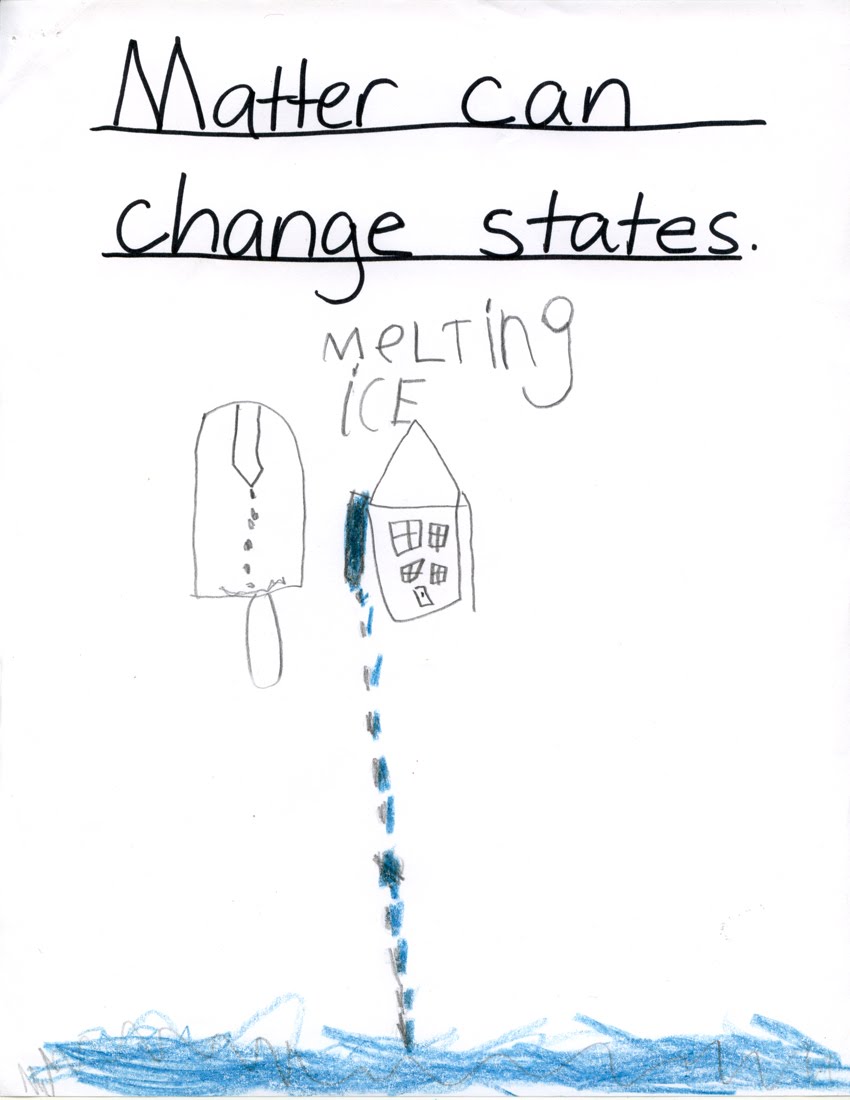
This week, building upon that idea, I introduced the concept of matter and its three states - solid, liquid, and gas. We found various items around the house and organized them into these three categories. I showed them that all of the liquids needed containers to keep them from flowing into the carpet. Josh even explained "viscosity" to them, and they could identify which liquids had higher or lower viscosity. We experimented with ice and butter on the stove and saw how matter could change from one state to another, and we also discussed how living things are a combination of the three states - not just one.

As a final project, I put together a small book, with a label or sentence on each page, and I allowed the kids to write and draw what they learned about matter. I gave them a lot of freedom, though I required that they write at least one thing on each page and I assisted them with spelling if needed. I was so impressed! Their books showed just how much they really learned about the subject:

Ben, age 5 (kindergarten):


Hannah, age 6 (first grade):


Saturday, June 19, 2010

A Creepy, Cool Bug

A few nights ago, I walked onto our porch to put cans in the recycling bin and noticed a strange looking bug on the screen. I called Josh to come look, and he captured the bug in a little bug cage to show the kids.

The kids squealed in fear, and I must admit that the bug looked quite dangerous. About an inch and a half long, it had a long, pointy tube on its back end with another thorn-like point above it. It looked like a very large wasp with two stingers, though I suspected it might use the long tube for laying eggs and not for stinging.

After some creative googling, we identified the species. It was indeed a wasp, though it was a wood-boring wasp and not a stinging one. In fact, this species could do more damage to local trees than to us, though we figured that out after we released it... The bug we found was a "pigeon horntail." It uses its long, slender ovipositor (that scary looking tube) to deposit its eggs into the wood of trees and then infects the trees with fungi in order to soften the wood for its larvae to eat. I hope that this particular pigeon horntail decided to lay its eggs in someone else's trees...

Anyway, after watching it for a few minutes, we let it go in our bushes. I did get one good picture of it, before it flew at me and I screamed and jumped away despite knowing that it could not do me any harm. It certainly looked intimidating!

Later that night, Hannah was excited to find the pigeon horntail listed in her little bug guide in her room. I actually enjoyed examining and learning more about it, even though I panicked just a bit at the thought of it landing on me... What a creepy and cool bug!

Sunday, December 27, 2009

Gifts for Growth

All three kids received many wonderful presents this year for Christmas. A few gifts, however, have captured their creativity and curiosity as they encourage them to develop their minds.

Ben's favorite gift this year is a Snap Circuit set, which allows him to build circuits that perform various functions. So far, he and Josh have built light switches, a musical doorbell, a radio transmitter that acts as a microphone, a "helicopter" launcher, and many others. Ben has learned how to create his own circuits as well. Yesterday, I heard a buzzing sound as he was playing and, concerned, I asked him what he was doing. "I accidentally bypassed the switch," he explained. "I'll fix it." He also surprised me by asking if I had seen the CV capacitor he needed. I had to tell him that I did not even know what a capacitor was!

Hannah has two gifts that she enjoys very much. We gave her a tub of craft supplies - tissue paper, streamers, stickers, feathers, rick-rack, doilies, googly eyes, pom poms, paper, pipe cleaners, and more. Additionally, we gave her a large roll of tape and a bag full of toilet paper rolls I had been saving. She has been cutting and gluing and taping and creating constantly since Christmas morning!

Well, almost constantly... Grandma and PopPop gave her the best gift this year. It is a kit with plastic dinosaur bones encased in stones. Using a chisel and a hammer, she has to chip away at the stones until she can extract all of the bones. When she finishes, she can assemble a complete model of a t-rex skeleton.

Unfortunately, we discovered that the stones fly all over the house when she chisels them, so she has to work on it outside. Grandma stood outside with her in the cold for hours yesterday as Hannah slowly and carefully tapped the tiny rocks off of the bones.

She has revealed a few bones so far, but I think this will be a long term project rather than a short term activity. Though she felt quite disappointed when she discovered that the bones are plastic and not real dinosaur bones, she still loves to work on it, practicing to become a paleontologist someday.

I love giving the kids gifts that encourage their minds and their creativity to grow. They focus so intensely, exploring and learning and experimenting, that I can almost see their little brains working. They each have such individual interests and aptitudes, and I enjoy watching them develop and grow as they get older. I wonder what they will be and how they will continue in their passions when they are adults. For now, though, I am glad to know that these gifts for growth are not only my favorites for them, but their favorites as well.

Monday, November 30, 2009

Bones and Stones

For Thanksgiving this year, we traveled to visit my dad's family in Pittsburgh, PA. In contrast to our very rustic Thanksgiving last year, we stayed in a hotel with my parents, my brother, and his girlfriend, and we ate our meal in the comfort of my aunt and uncle's home, driving to my grandparent's house for dessert. We had a wonderful time visiting family, many of whom the kids have not seen in a couple of years.

On Saturday, we decided to enjoy Pittsburgh a bit, so we headed across the city to the Carnegie Museum of Natural History. What a wonderful museum! I knew they had a great dinosaur exhibit, but I never expected the kids to get so excited about the gems and minerals exhibit. All three kids were completely enthralled with the beautiful rocks and crystals.

Hannah thought they were beautiful and suggested that maybe she would rather be a geologist than an entomologist when she grows up. When we asked Becca about her favorite part of the museum later, she told us, "The rocks. They were pretty and shiny and sparkly and glowy in the dark..." She was adorable!

As I expected, the kids loved the dinosaur exhibit as well. The display had full skeletons of all of the dinosaurs most kids would readily recognize - apatosaurus, diplodocus, triceratops, stegosaurus, and of course, tyrannosaurus rex.

The museum also had many lesser known dinosaurs and another gallery dedicated to Ice Age animals, like mammoths and mastodons.

After viewing all of the wonderful skeletons, we arrived at a section geared entirely towards kids - "Bonehunter's Quarry." Many skeleton replicas lay buried in a waxy clay-like substance. Children first donned a pair of safety goggles and then used a chisel and a paintbrush to carefully excavate the bones. All three kids loved this part - especially Hannah! They definitely learned that uncovering dinosaur bones is a delicate and difficult job, requiring a lot of patience.

We spent the majority of our time in these two sections, but the museum had many more wonderful displays - North American and African animals, birds, Native Americans, Egypt, life in the Polar regions. We did walk through most of the exhibits, but by the end, the kids were tired and ready for lunch. We all had a great time and learned quite a bit, and I think if we go back, we will start on the top floor and work our way down so we can spend more time in some of the displays we missed or rushed through this time.

After a nice lunch, we returned to the hotel for a lazy afternoon. Becca took a nap while Hannah and Ben played with Grandma and PopPop in their hotel room. Well, they played for a little while until they both succumbed to their sleepiness and took a nice long nap on my parents' bed.


Aren't they sweet?

I love museums, and I think I will use this one as a starting point for a long unit on dinosaurs. I have a great book full of dinosaur-themed activities for Ben, and I just finished reading him Dinosaurs Before Dark last month. Now I just need find a way to work some geology into the unit, as well!

Where homeschooling is just a small part of becoming life-long learners.